Night journey · 7 minutes
The Sleeper to the Coast
A sleeping-car attendant keeps the corridor while the train waits for the sea.
From the recurring world Small Stations After Midnight
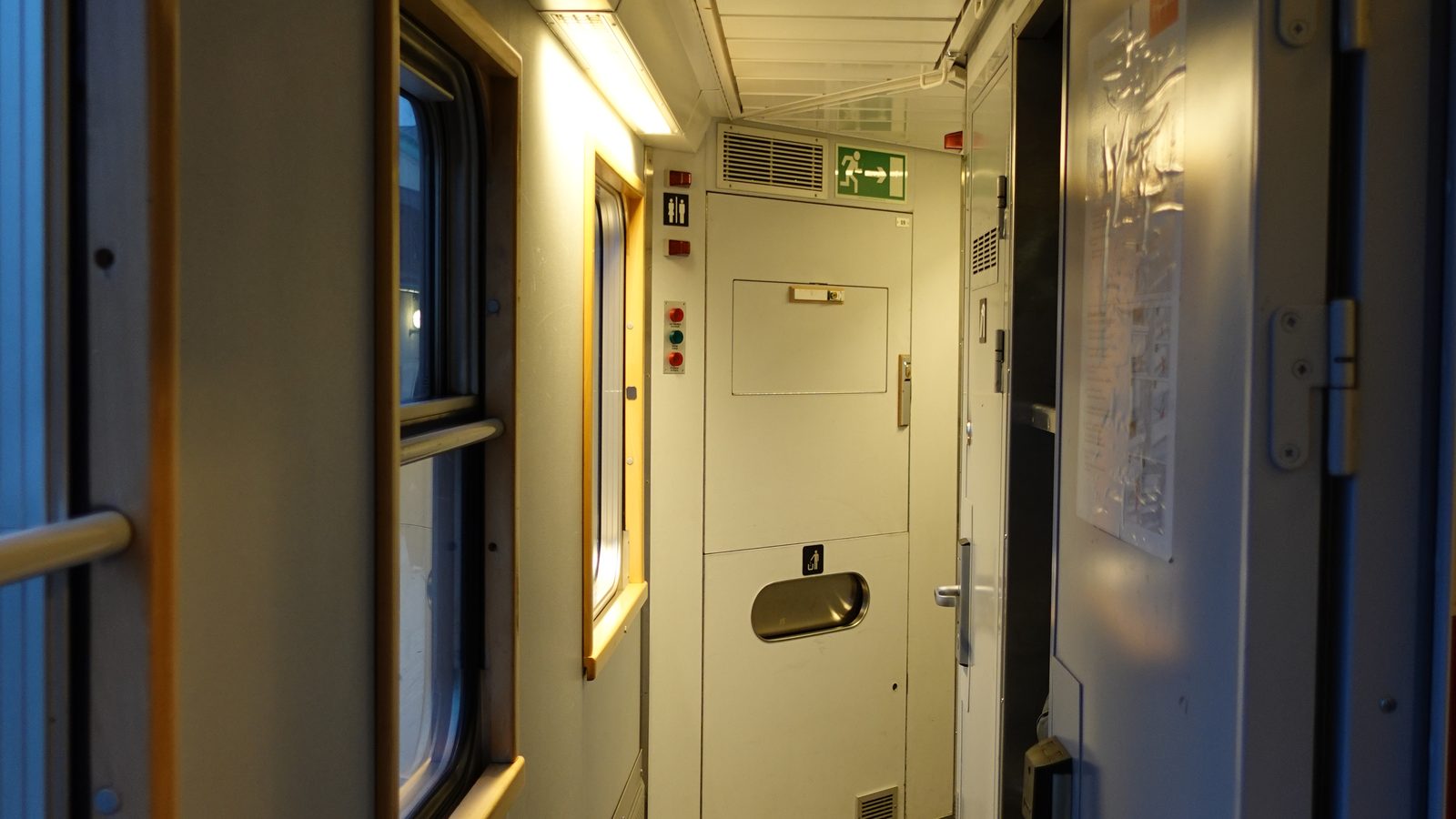
Begin readingBy two in the morning the sleeping car had become a corridor of closed doors and one lamp. Hanne walked its length every half hour, not because anything needed doing, but because a corridor that is walked stays a corridor, and one that is not becomes a tunnel.
The carriage was the old kind, wood-panelled, with a folding seat under each window that nobody used and a brass rail at hip height that everybody did. Nine compartments, eight of them taken. Behind the doors her passengers slept in their narrow berths with their shoes lined up and their tickets tucked into the little frames she had shown them, and the train carried all of them west through the dark at the speed of a person walking briskly, which was as fast as the night line ever went and faster than any of them needed.
She had a small cabin of her own at the end of the car, with a kettle and a folding table and a window that looked backward along the train. From it she could watch the last carriage sway and the rails come out from under it, silver for a moment and then gone. She did not sleep on these runs. She had learned to rest instead, which was a different thing: to sit with the kettle ticking and her hands in her lap and let the train do the moving, the way one lets a river do the moving from a boat.
At a quarter past two the train slowed and stopped. There was no station, only a signal showing red above a field, and the low sound of the engine waiting. Hanne knew the place. A goods train came the other way at this hour and the night line stood aside for it here, on a loop of track between two woods, for six or seven minutes. She opened her window a hand’s width. The air that came in smelled of cut grass and of something farther off that might have been the sea or might have been her wanting it to be.
The door of compartment four opened. An old man in a cardigan stood in the corridor looking at the field as though he had ordered it. He was going to the coast, he had told her at the start, to see the water, which he had not seen for eleven years, and he had asked her to wake him if there was anything worth looking at on the way. Hanne had said there would not be. There was only the dark and then, at the end, the sea. He had said that was what he wanted.
She made him tea. It was the small work she liked best, the kettle and the two cups and the little pot with its dented lid, and the old man held his cup in both hands and stood at the window while the goods train went by in the other direction, a long slow procession of wagons with no lights at all, only the sound, which filled the corridor and then thinned and then was gone into the wood. The signal changed. The night line gathered itself and moved.
They stood together a while longer, saying nothing much. He told her the name of the village he had been born in, which was near the coast, and that the house was gone but the lane was still there, and she told him that the lane was generally the thing that stayed. Then he thanked her for the tea, and went back into compartment four, and she heard the berth take his weight and the small sounds of a person settling, and after that nothing.
Hanne walked the corridor. Eight doors, all closed. The lamp at the far end. The brass rail cool under her hand. Through the windows on the other side the country had begun to change without announcing it: the woods had given way to flat fields, and the fields to something flatter, with ditches in it and a line of poles, and the sky in the west, which should have been the darkest part, had a faint grey lift to it that she knew was not dawn. It was the light that water gives back, even at night, even from a long way off.
She went back to her cabin and sat with the window open its hand’s width. The smell had made up its mind now. Salt, and mud, and the cold clean edge of a shore. Somewhere ahead the line would swing along an estuary and the passengers, if they were awake, would see the sea come up beside them as grey as the sky, and one of them would be standing at a window with his shoes on, ready. The rest could sleep. Hanne watched the rails come out from under the last carriage, silver and gone, silver and gone, and let the train carry the whole sleeping length of the corridor down toward the coast at exactly the speed of a walk.
You do not need the screen to keep this place. Close your eyes and let it continue without us.
Let the screen go darkPhotograph: G och J, CC BY 4.0, Wikimedia Commons