Night journey · 6 minutes
The Train That Stopped at San Lucido
A railway carriage, a hillside station, and a town still awake enough to leave one lamp burning.
From the recurring world Small Stations After Midnight
Begin readingThe train had been following the river for so long that the sound of water and the sound of wheels had become almost the same sound. In the dark window, Elias could see the faint reflection of his reading lamp, the brass latch above the door, and now and then a pale length of river bending away beneath the mountains.
He had stopped reading an hour ago, somewhere after the last lit town, and had let the book close over his thumb. The carriage was old in the way that made it comfortable rather than shabby: a folded blanket on every seat, a luggage rack of polished wood, a little enamel plate above the window that asked, in three languages, that it not be opened while the train was moving. Nobody in the carriage had any wish to open it. There were four other passengers, and all of them had gone quiet in the same hour, as if the river had asked them to.
San Lucido was not printed in the timetable. The conductor spoke its name softly as he passed: a short stop, he said, for water and a parcel of letters. Outside stood a platform no longer than two carriages, a wooden bench, and a station clock that appeared to be considering the hour rather than declaring it.
The train slowed the way a person slows at the top of a stair, out of habit more than need. Brakes sighed. A lamp on the platform swung once on its chain and then decided to hang still. Through the glass Elias watched the stationmaster come out of a small office with a cap in one hand and a cup in the other, and set the cup down on the bench so that he could raise the cap to the driver. It was the kind of greeting exchanged between people who saw each other every night and had never once needed to say more.
Elias stepped down simply to stretch his legs. Above the station, a cobbled lane climbed between dark houses. Most windows were unlit. One held the square amber glow of a kitchen where someone had left a loaf beneath a cloth. Farther uphill, three plane trees moved a little in the night breeze.
The air was cooler than the carriage and smelled of the river and of woodsmoke from a chimney he could not see. Somewhere up the lane a shutter was fastened, two short sounds and then nothing. He walked a few paces toward the cobbles and stood where the platform ended and the town began, and found that he had no wish to go farther. It was enough to know that the lane continued, that it turned somewhere past the plane trees, and that the people who lived along it were mostly asleep.
There was no reason to hurry. The parcel of letters was still being carried from a blue cart. Elias walked to the end of the platform and looked across the valley. Tiny lamps rested along the road on the opposite slope, each one far enough from the next to leave a comfortable darkness between them.
He counted them without meaning to, lost the count at nine or ten, and did not begin again. Below the road the river showed itself as a slightly paler darkness, moving the way it had been moving all night, and he understood that it would go on past the station, past the town, and out toward wherever the train was going, without being in any hurry to arrive there first. The stationmaster had finished his cup. The letters were aboard. Nobody called out; the driver simply waited a moment longer, the way one waits for a guest to finish looking at a view.
When he returned to the carriage, the blanket on his seat was still folded as he had left it. The train moved again without a whistle. San Lucido slipped behind the curtain, then the river returned, and then there was only the lamp, the low movement of the carriage, and the thought of a quiet lane continuing uphill without needing him to know where it ended.
He unfolded the blanket at last and put out the reading lamp. In the dark glass the reflection of the carriage went away and the valley came back, lamp by lamp, until the last of them was behind him. The wheels found their rhythm and the river found its own beside them, and once more the two sounds became almost one sound, and Elias let it carry him on toward morning.
You do not need the screen to keep this place. Close your eyes and let it continue without us.
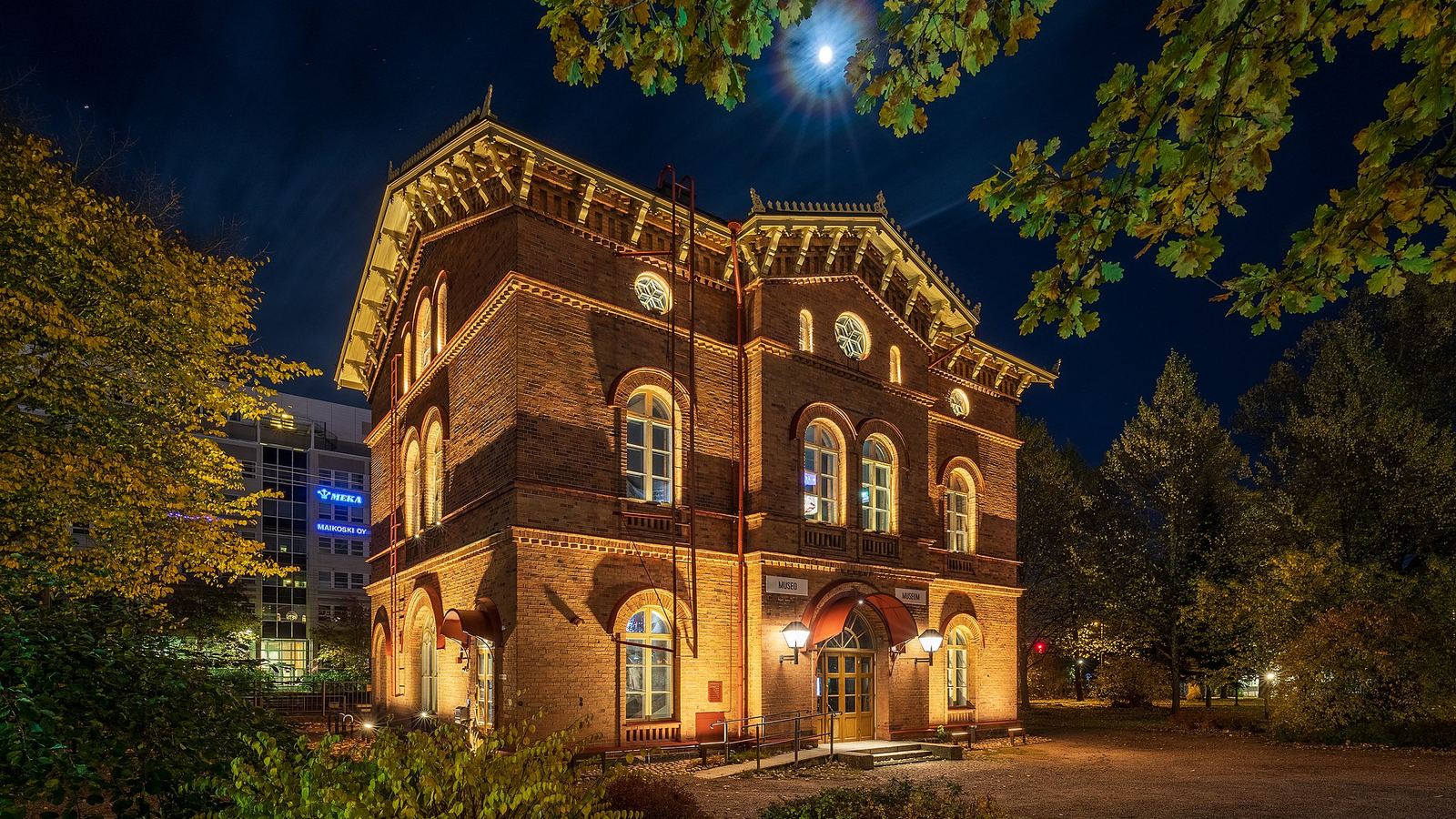
Let the screen go darkPhotograph: Ximonic (Simo Räsänen), CC BY 4.0, Wikimedia Commons