Place portrait · 6 minutes
The Shepherd’s Hut in October
A wheeled hut, a small stove, and a flock lying pale along the wall of a dark hill pasture.
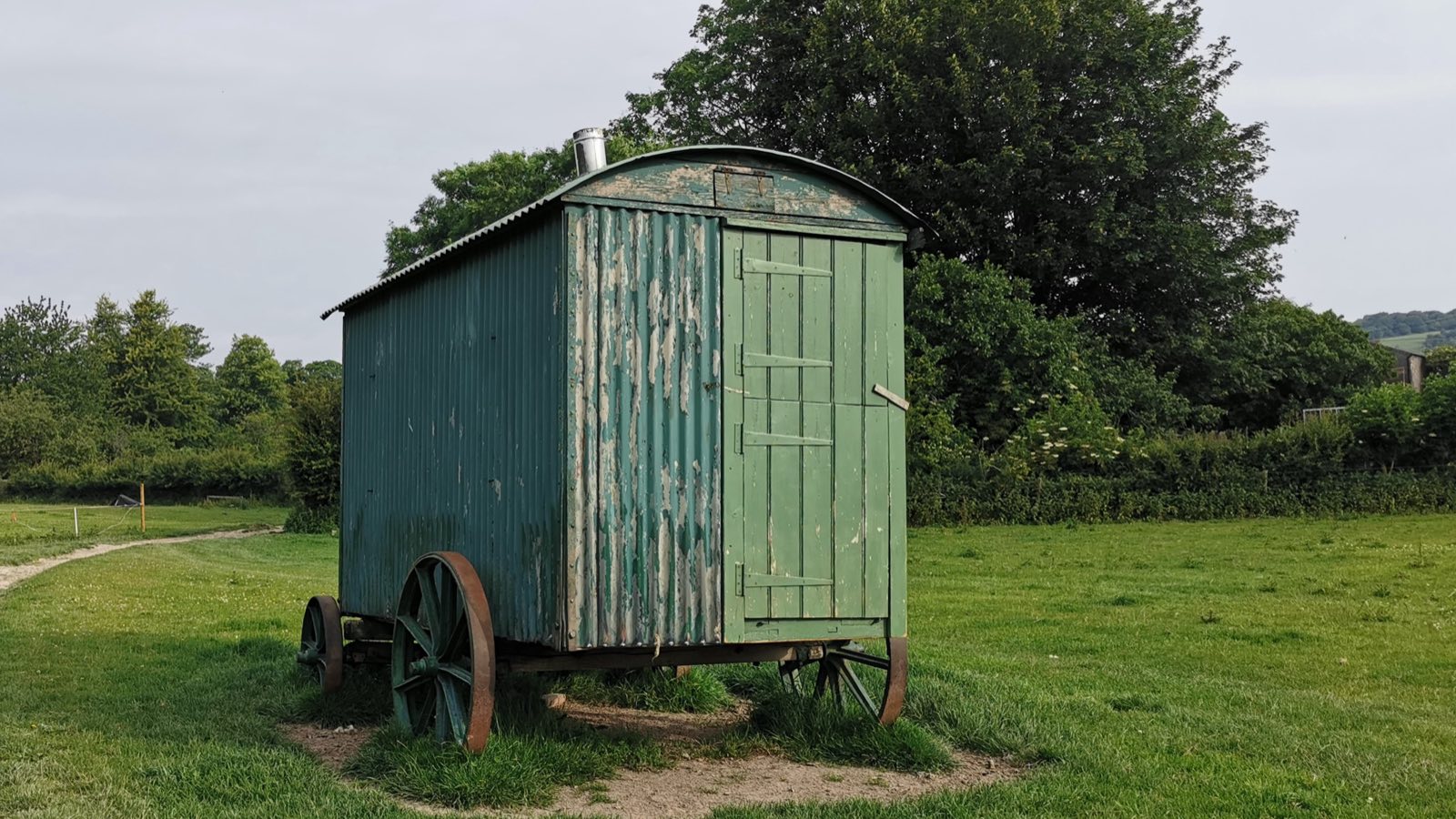
Begin readingThe hut stood on four iron wheels at the top of the hill pasture, where it had been drawn up in September and would stay until the flock came down in November. It had been painted green a long time ago, and the paint had weathered to the colour of lichen, so that from the valley it looked less like something built than something that had grown there. Gwil had come up after supper with a loaf, a tin of tea and a paraffin lamp, as he did on most October nights, though there was no particular need, except that the sheep were up there and he liked to be near them.
Inside, the hut was hardly bigger than a large table. There was a narrow bunk across the far end, a stove no bigger than a bread bin with a tin chimney going up through the roof, a shelf, a hook, a stool and a small window on either side. He lit the stove with a twist of newspaper, a handful of dry gorse and a few lengths of split ash from the box under the bunk, and it took at once, as small stoves do, and in a few minutes the hut was warm enough for him to take off his cap.
He made tea in a dented kettle and sat on the step with the door open to drink it. The pasture fell away below him in the last of the light, rough grass and rushes and a stone wall running crooked down toward the beck. The sheep were spread across the slope in no particular order, grazing a little and then not grazing, drifting slowly toward the lee of the wall, where they always lay at night. Nothing about them needed his attention. He watched them anyway, the way one watches a fire.
The light went gradually and then all at once, the way October light goes on a hill. The wall vanished, and then the rushes, and the sheep became paler shapes on a dark field, and then they too were hard to make out. A curlew called once from somewhere near the beck, a long falling note, and did not call again. The wind came up a little from the west and moved through the grass with a sound like the sea heard from a long way inland.
Before he turned in he took the torch from its hook and walked a little way down the slope. He did not go far. He stood where the ground levelled and moved the beam slowly along the foot of the wall, and the sheep showed in it one after another: pale backs, a lifted head, two green points of eyes that blinked and went away. He counted them as the light passed, in the old numbers his father had used, which ran to twenty and then began again. There were as many as there had been in the morning. He had not expected otherwise. He switched off the torch and let the dark come back over them.
In the hut he put one more length of ash in the stove and closed the damper down so that it would burn low until morning. He hung his coat on the hook, set his boots under the bunk with their toes together, and turned the lamp down to a small blue bead of flame, and then out. The stove kept a dim orange line around its door. The tin chimney ticked as it cooled.
He lay on the bunk under two wool blankets that smelled faintly of sheep and of the cedar chest they lived in through the summer. The hut moved very slightly on its wheels when the wind leaned on it, not enough to rock, only enough to let him know it was there. Through the small window he could see a few stars and the edge of a cloud with no moon behind it. Outside, the grass went on with its long hush. Somewhere down the slope a ewe shifted and settled.
There was nothing else, and Gwil had come up the hill for exactly that: a warm small room, a field of sleeping sheep, and the wind going over everything without wanting anything from it. He thought for a while about the gate at the bottom that needed a new hinge, and then about nothing in particular. The orange line of the stove and the stars in the window and the hush of the grass became one quiet thing, and the hill kept the flock, and the flock kept the hill, and nobody needed to count anything again until morning.
You do not need the screen to keep this place. Close your eyes and let it continue without us.
Let the screen go darkPhotograph: Paul Farmer, CC BY-SA 2.0, Wikimedia Commons