Gentle work · 7 minutes
The Lock-Keeper’s Last Boat
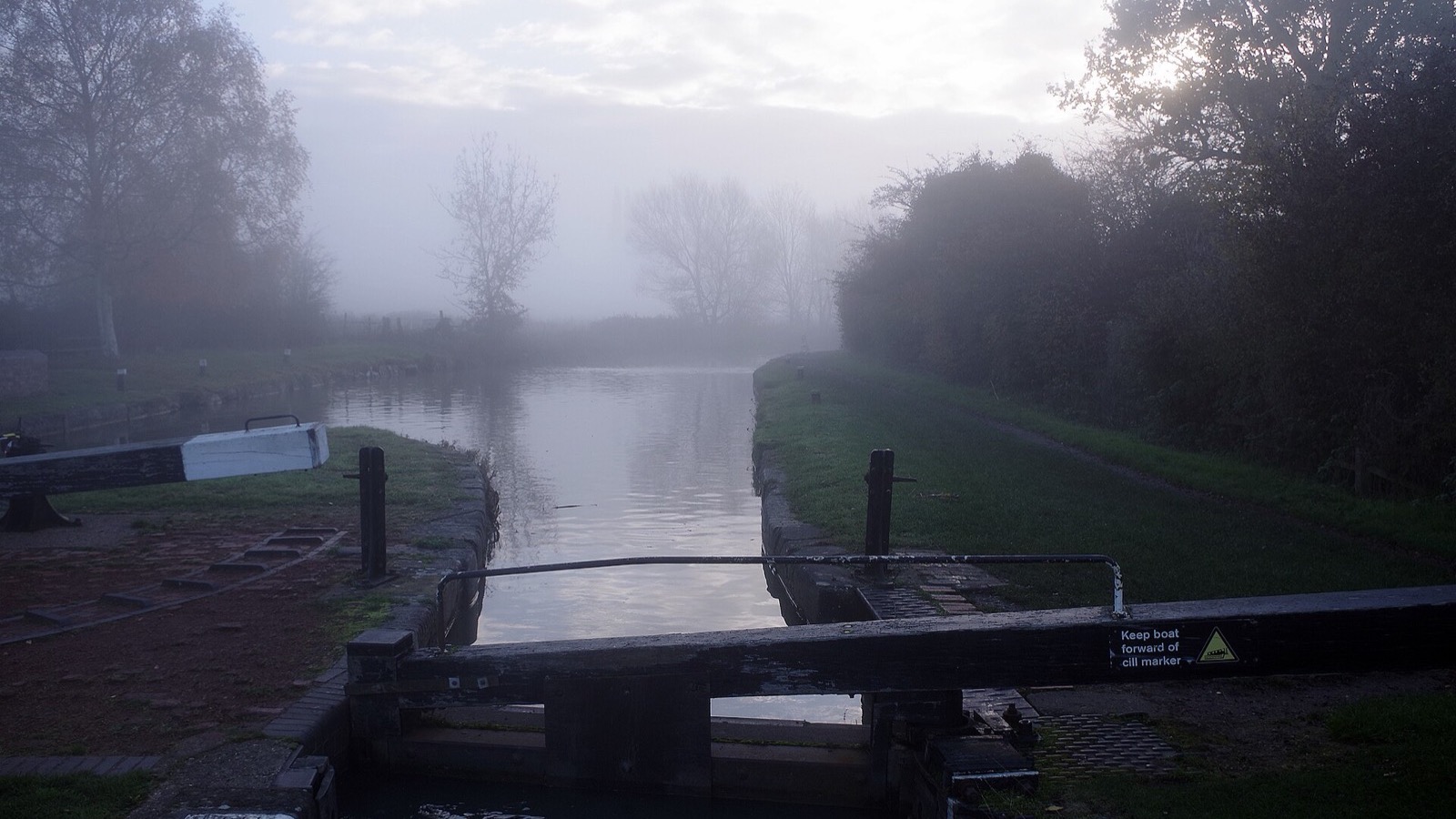
At dusk on the canal, a lock-keeper lifts one slow narrowboat up the hill and walks home in the mist.
From the recurring world The Gentle Trades
Begin readingThe last boat of the day came round the bend below Ashby lock a little after six, with its tiller lamp already lit though the sky had not quite finished being light. Corin heard it before he saw it: the slow knock of an old engine that had been running since morning and saw no reason to change its mind now. He leaned the leaf rake against the balance beam and went down to stand by the bottom gates.
It was early October, and the canal had begun its autumn habit of collecting things. Willow leaves lay along the edges in narrow yellow rafts. A few chestnut leaves, larger and more deliberate, turned slowly in the middle as if they had somewhere to be and were in no hurry to get there. Corin had raked the lock side twice since lunch and would rake it again tomorrow, and the trees would go on letting go regardless, which was how it should be.
The boat was called Little Wren, painted green and cream, with a row of geraniums on the roof that had decided to keep flowering a week longer than anyone expected. A man stood at the tiller in a woollen hat; a woman sat on the roof beside the geraniums with a mug held in both hands. Corin set his shoulder to the beam, walked the bottom gate open in its long, creaking arc, and the man brought the boat in so gently that its fenders barely kissed the wall.
There was a pleasant order to the work, and Corin did not rush any of it. He closed the bottom gates behind the boat, one and then the other, and crossed the little footbridge to the top. He fitted the windlass to the first paddle and wound, and the ratchet clicked over tooth by tooth, and somewhere under the black water the paddle lifted and the canal above began to pour in. It came with a low, full sound, like a bath being run in another part of a large house, and the boat began to rise.
It rose slowly. The wet stone of the chamber appeared and disappeared again as the water climbed it, and the woman on the roof came up past the coping a little at a time, first her hat, then her face, then the mug, then the geraniums. She asked whether he got many boats this late in the year. Not many, he said; a few each day, and fewer each week, until by November it would mostly be him and the moorhens. She said that sounded rather nice. He agreed that it was.
When the levels were even the water went quiet all at once, the way a room goes quiet when a clock stops, and Corin leaned on the top beam until the gate gave and swung. The man at the tiller lifted a hand. The woman held up her mug in a small salute. Little Wren slid out of the lock and on toward the long straight past the farm, its lamp growing smaller, its engine knocking along at walking pace, and the wash it left behind went out to both banks and set the willow leaves gently rocking.
He closed the top gates, lowered the paddles, and hung the windlass on its nail inside the hut. The lock was full now and would stay full overnight, holding a long rectangle of sky that was deepening from grey to blue. He wrote the boat in the book on the shelf: its name, the time, upward, two aboard. It was the eleventh entry of the day. The pencil had a flat side worn into it from years of being held in exactly the same way.
Then he walked home along the towpath. Mist was rising off the canal, not thickly, just enough to soften the far bank and give the water a faint breath of its own. The hedges smelled of damp leaves and blackberries gone past their best. A heron stood in the shallows below the farm bridge and did not move as he passed, having long ago decided that Corin was part of the canal. Under the bridge his footsteps came back to him once, and then the arch let them go.
His cottage stood a quarter of a mile on, its kitchen window the only light along that stretch. Before he went in he looked back the way he had come. The lock was out of sight now, and the boat had gone wherever boats go after dark, and the mist had settled along the water in a long, low line, keeping the canal company. The leaves would keep falling all night. In the morning there would be more to rake, and the gates would be there, and the water would be waiting at the level he had left it.
You do not need the screen to keep this place. Close your eyes and let it continue without us.
Let the screen go darkPhotograph: Stephen McKay, CC BY-SA 2.0, Wikimedia Commons