Quiet story · 7 minutes
The Piano Tuner’s Last House
A travelling piano tuner works one note at a time while a farmhouse goes to bed around him.
From the recurring world The Gentle Trades
Begin readingThe farmhouse was the last on Bram’s list, and the farthest, at the end of a lane where the hedges met overhead and his headlamps made a green tunnel of them. It was a little after eight when he knocked. October had brought the dark down early, and the yard smelled of wet straw and windfall apples, and somewhere in a barn a cow shifted her weight and sighed, as if she too had been on her feet all day.
The farmer’s wife let him in with a tea towel over her shoulder and showed him to the front parlour. The piano stood against the inside wall, an upright of dark walnut with brass candle holders folded flat against its front and a lace runner along the top, on which rested a clock, two photographs and a china dog. She moved them carefully to the sideboard so that he could lift the lid. It had not been tuned, she thought, since her mother’s time, though her son played it on Sundays and said it sounded like a chapel in the rain.
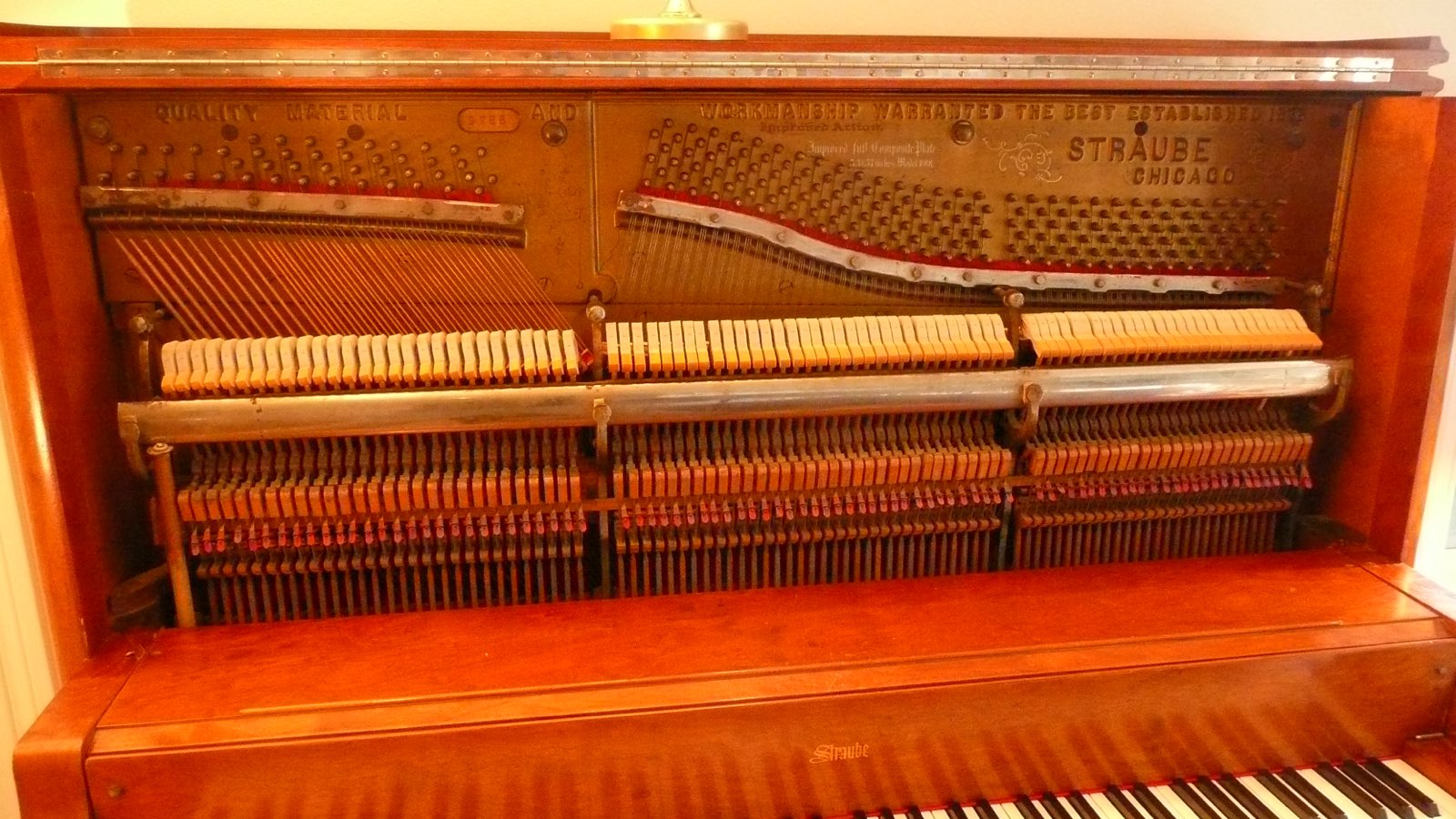
Bram opened his case on the rug. Inside, each in its felt-lined place, lay the tuning hammer with its worn wooden handle, a fork that gave a clean A when he tapped it on his knee, a few rubber wedges, a roll of felt strip and a small torch he hardly ever needed. He took off the front panel and set it against the wall, and the piano stood open before him, all its strings and dampers and little felt hammers in rows, like the inside of a clock that had decided to sing.
He began in the middle, as he always did. He struck the fork, held it to the wood, and played the A beside it, and listened to the two sounds lean against each other with a slow wavering, a beat, like a breath taken in and let out. He fitted the hammer onto the pin and turned it the smallest amount, less than a hair, and the wavering slowed, and slowed, and was gone. Then the second string of the same note, then the third. From there he worked outward one interval at a time, striking each note again and again, softly, the way someone knocks at a door they know will be opened.
The household went on around him. In the kitchen a tap ran and was turned off. The farmer came in from the yard, said good evening to the piano rather than to Bram, and went upstairs in his socks. A boy in pyjamas appeared in the doorway, watched for a while with great seriousness, and was called away to bed. Bram heard the stairs take each of them in turn, the third step from the top creaking for everyone, then doors closing along the landing, water in the pipes, and a slow thinning of sound as the house began to settle.
He worked down into the bass, where the strings were wound with copper and the notes came up through the floorboards as much as through the air, and then up into the treble, where they were thin and bright and brief, and he had to lean close to hear the beats at all. A moth came to the lamp and went round it. The clock on the sideboard ticked in a key of its own. Once the farmer’s wife put her head round the door to say she had left cake in the kitchen and the back door on the latch, and that he was not to hurry; then she went up too, and the stairs creaked, and the house belonged to Bram and the piano.
It was past ten when he struck the last note at the top and found nothing more to do. He rolled up the felt strip, slid the wedges into their pocket, replaced the panel, and set the clock, the photographs and the china dog back on the lace runner exactly where they had been, the dog facing the window as before. Then he sat down on the stool, which was a little low for him, and rested his hands on the keys.
He played one chord, slowly, low in the middle of the keyboard, and held it. It filled the parlour without being loud, every string in agreement with every other, and went on sounding after he lifted his hands, softer and softer, until he could not tell whether he was hearing it or remembering it. Upstairs nobody stirred. He closed the lid over the keys.
In the kitchen he ate the cake standing up, wrapped a second slice in a paper napkin for the drive, and wrote on the back of his card that the piano had been tuned and should hold until spring. He left the card under the sugar bowl. The back door opened onto a yard gone silver under a half moon, the barn dark, the apple smell stronger now that the air was cold. He let the latch down behind him without a sound, and in the dark parlour the piano kept its tune for nobody at all, as it would go on keeping it, a little less each week, all through the winter.
You do not need the screen to keep this place. Close your eyes and let it continue without us.
Let the screen go darkPhotograph: nwclassicyacht, CC BY 2.0, Wikimedia Commons