Mountain story · 7 minutes
The Weather Station on the Ridge
A volunteer observer climbs to a small station for the nine o’clock reading as the cloud comes in.
Begin readingThe weather station stood at the end of the ridge, a quarter of an hour’s walk above the last farm, and Huw had been climbing to it at nine o’clock every evening for nineteen years. He went up in all weathers, which was rather the point. Tonight it was dry and mild for early October, and he took the path slowly, with a torch in his coat pocket that he did not yet need.
The path went up between bracken that had turned the colour of old pennies. Sheep lay in the hollows like scattered stones and watched him pass without getting up. Halfway along there was a gate that had to be lifted before it would open, and a flat rock beside it where he always stopped to look back at the valley. The village had put its lights on: the long string of the main road, the square glow of the pub, the single lamp outside the chapel that the caretaker had forgotten to switch off for most of the last decade.
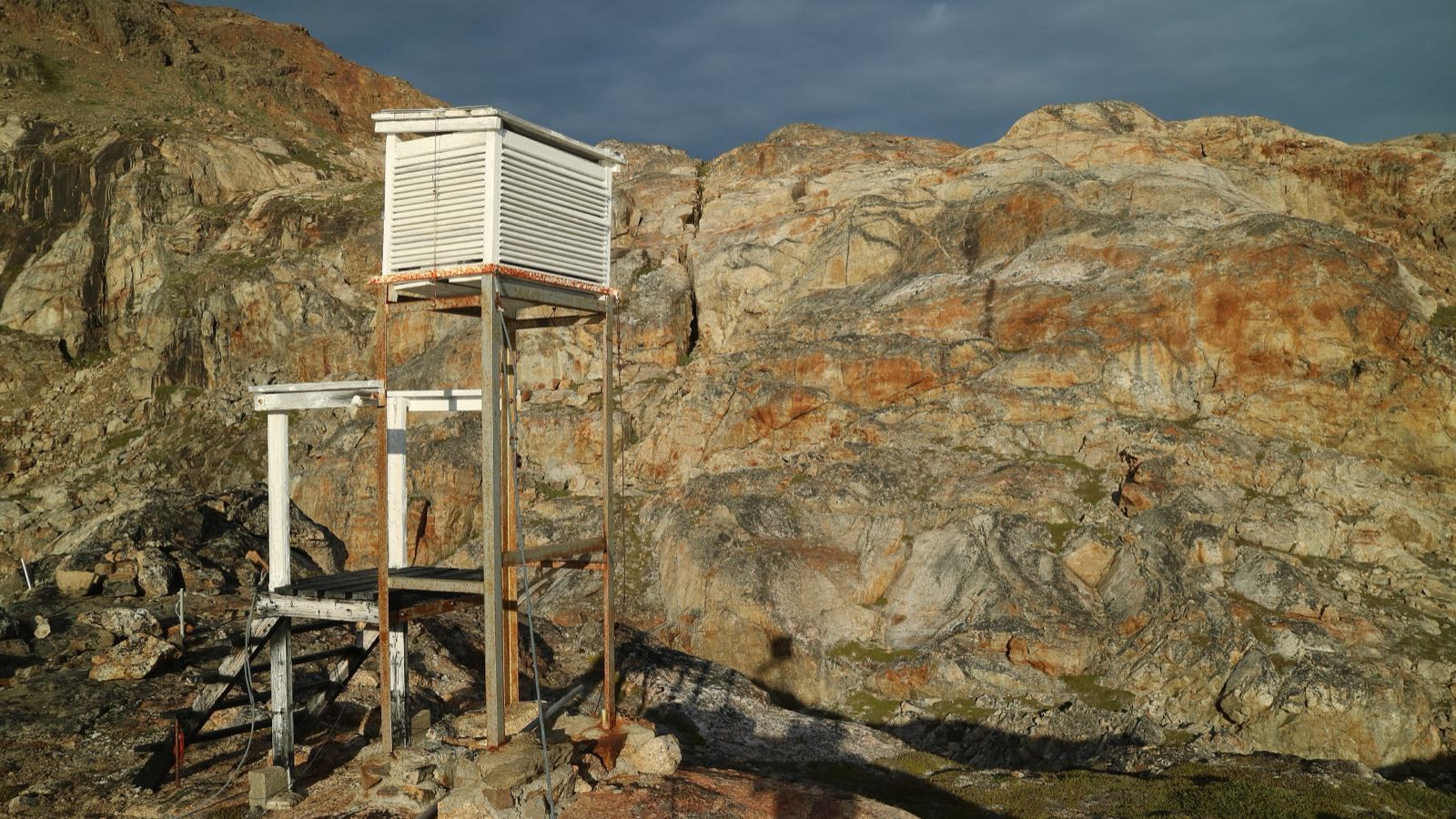
The station itself was a small fenced square of short grass with a white wooden box standing on legs in the middle of it. The box had louvred sides, like a set of shutters closed against the afternoon, so that the air could move through it while the sun could not. Beside it stood a copper rain gauge, a wind vane on a pole, and a wooden post with a metal tag on it that gave the height of the ground above the sea, in case anyone up here had forgotten.
Huw opened the gate in the fence and latched it behind him. He took out the torch now, because the light was going, and opened the door of the white box. Inside, the thermometers hung in their frame, slim glass tubes with fine black marks along them, and he leaned close to read each one in turn: the dry bulb, the wet bulb, the maximum, the minimum. He read them twice. He always read them twice, not because he had ever been wrong, but because the second reading was the one that let him be sure.
He wrote the figures in the ledger, which he kept in an oilcloth bag inside the box. The pages were ruled into narrow columns, one row for every day, and his handwriting went back through them in pencil for nineteen years, occasionally interrupted by the neat, slanting figures of his neighbour, who did the readings whenever Huw was away. Ten point four. Eight point nine. A light westerly. Then he reset the maximum and minimum with a small magnet, closed the box, and went to the rain gauge.
There was a little water in it from the morning shower. He poured it into the glass measure and held the torch behind it, and the water caught the light and showed him two point one millimetres, which he wrote down. It was pleasant, he thought, to be the only person in the valley who knew exactly how much rain had fallen on the ridge today. It was not a fact anyone would ask him for tomorrow. One day, perhaps years from now, somebody at a desk would put his column beside a thousand other columns and find something worth knowing in it, and that could happen in its own good time.
While he had been writing, the cloud had come in. It arrived from the west the way it often did, not as a wall but as a gradual softening, so that the far hills went first and then the nearer ones, and then the edge of the ridge itself. The valley lights grew blurred and golden, and then most of them went out of sight altogether, though he knew perfectly well they were still there. The air smelled of wet stone and cold grass. Somewhere below, invisible now, a sheep made its one comment on the matter.
Huw put the ledger back in its bag and the bag back in the box, and fastened the door. He stood for a moment inside the little fence with the torch pointed at the ground, listening to the cloud settle around the station, the faint tick of moisture gathering on the wind vane, the soft hiss of the bracken. The numbers were written down. The instruments would go on measuring all night without him, the thermometers holding their small records of the dark, the gauge waiting for whatever rain came next.
He latched the gate and started back down the path, following the circle of torchlight through the mist. At the flat rock he stopped, out of habit, though there was nothing to see now but white. Then the cloud thinned a little, and the chapel lamp came through it, faithful and slightly blurred, and Huw went on down toward it, one step at a time, leaving the ridge to its weather.
You do not need the screen to keep this place. Close your eyes and let it continue without us.
Let the screen go darkPhotograph: Clemens Stockner, CC BY-SA 4.0, Wikimedia Commons